Case study · 2026
Yatara Property Maintenance
Turning a service catalogue into a quoting and operations system.
My role: Requirements interpretation, system design and full-stack implementation
Visit site (opens in new tab)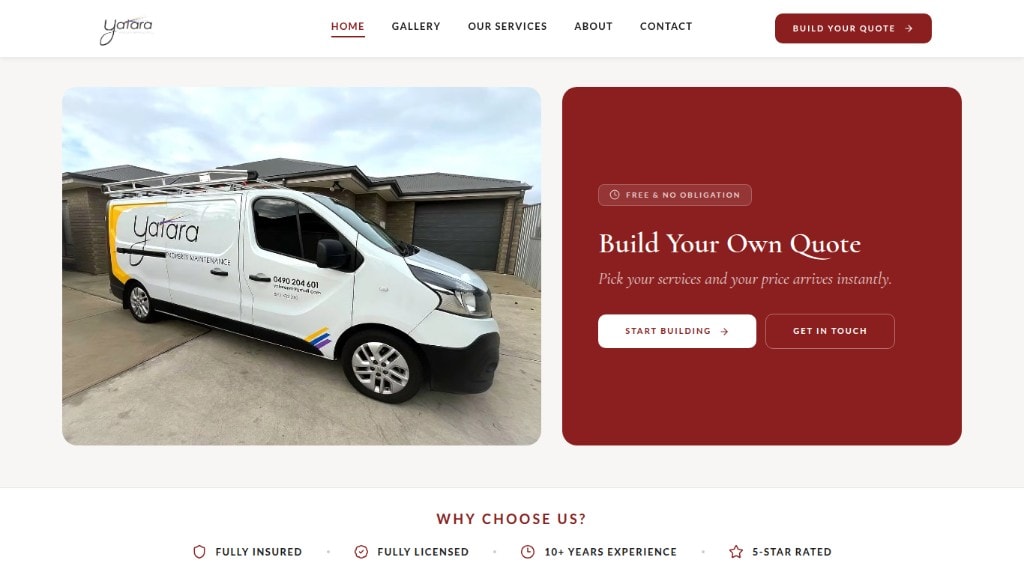
Overview
Yatara is a property maintenance business in Adelaide. I took the customer's requirements and made the product and system decisions needed to connect their services, pricing, quoting and staff workflows.
The problem
The challenge went beyond presenting services on a website. A customer needs to choose the right work and options, while the business needs that selection to fit its pricing and operational process. Treating every service as a separate hardcoded page would leave those relationships scattered across the application.
What I built
I designed the quote flow around the structure of the service catalogue. That gave the customer-facing journey and the business workflows a shared model to build on.
- Service catalogue and pricing connected to the customer quote journey.
- Customer and booking flows supported by staff and admin operations.
- A public website that provides an entry point into the underlying business system.
Design decisions
Model services as a hierarchy
The catalogue follows a tree-like structure: a parent service can contain child services and options. Relationships describe how a customer moves from a broad requirement to a specific selection, allowing the quote flow to follow the catalogue rather than a collection of independent pages.
Account for how often the catalogue changes
The service structure changes relatively infrequently. That makes the hierarchy suitable for caching, rather than repeatedly reconstructing the same relationships for each step of a quote.
Trade-offs
- A shared service model takes more initial design work than separate pages. In return, the quote journey can follow explicit service relationships as the catalogue evolves.
The outcome
The delivered system brings customer quoting and the business's service, pricing and staff workflows together. It is an example of taking a customer's operational requirements through system design and implementation, rather than only building the public website.